
How to Tell If a Rug Is Handmade
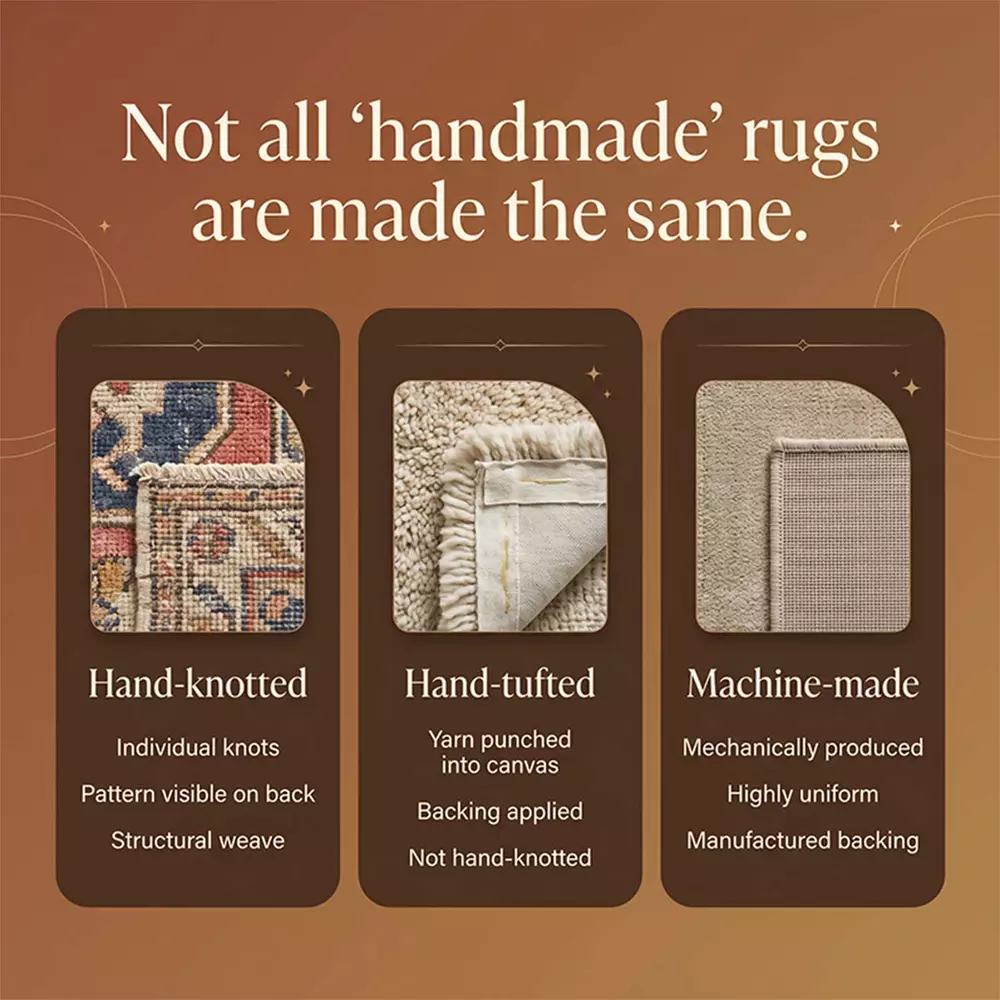
There's a moment most people have had, standing in a shop, or crouched over something rolled out on a showroom floor, or halfway through a listing that says "handmade, "when they wonder if it actually is. The word gets used loosely. A rug can be described as handmade when it was tufted by a pneumatic gun in a factory, or woven on a mechanised loom with a single operator overseeing dozens of machines. The gap between that and a genuinely hand-knotted or hand-woven piece is enormous, not just in terms of craft, but in how a rug will actually live in your home over years and decades.
Knowing the difference isn't specialist knowledge. It's mostly a matter of knowing what to look for, and being willing to get close.
Turn It Over First
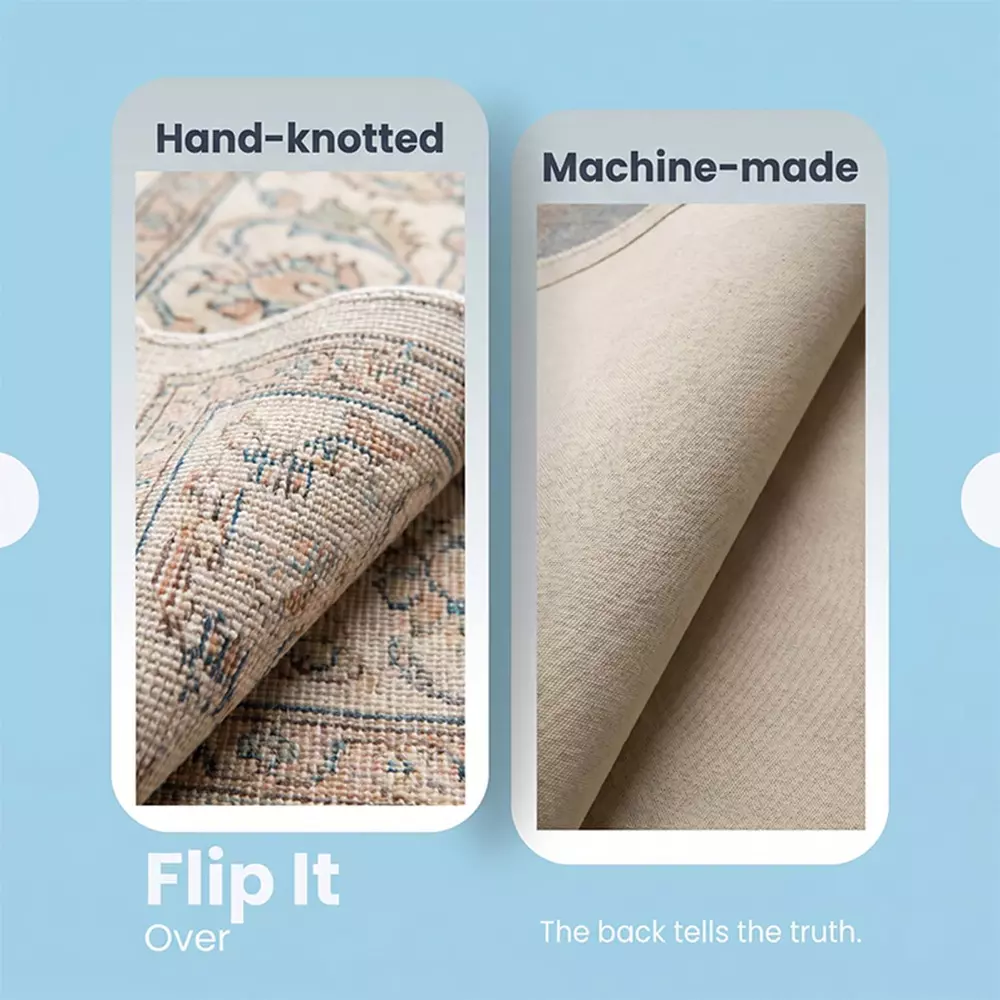
If there's a single rule when evaluating a rug, it's this: flip it over. The underside is almost always more honest than the face.
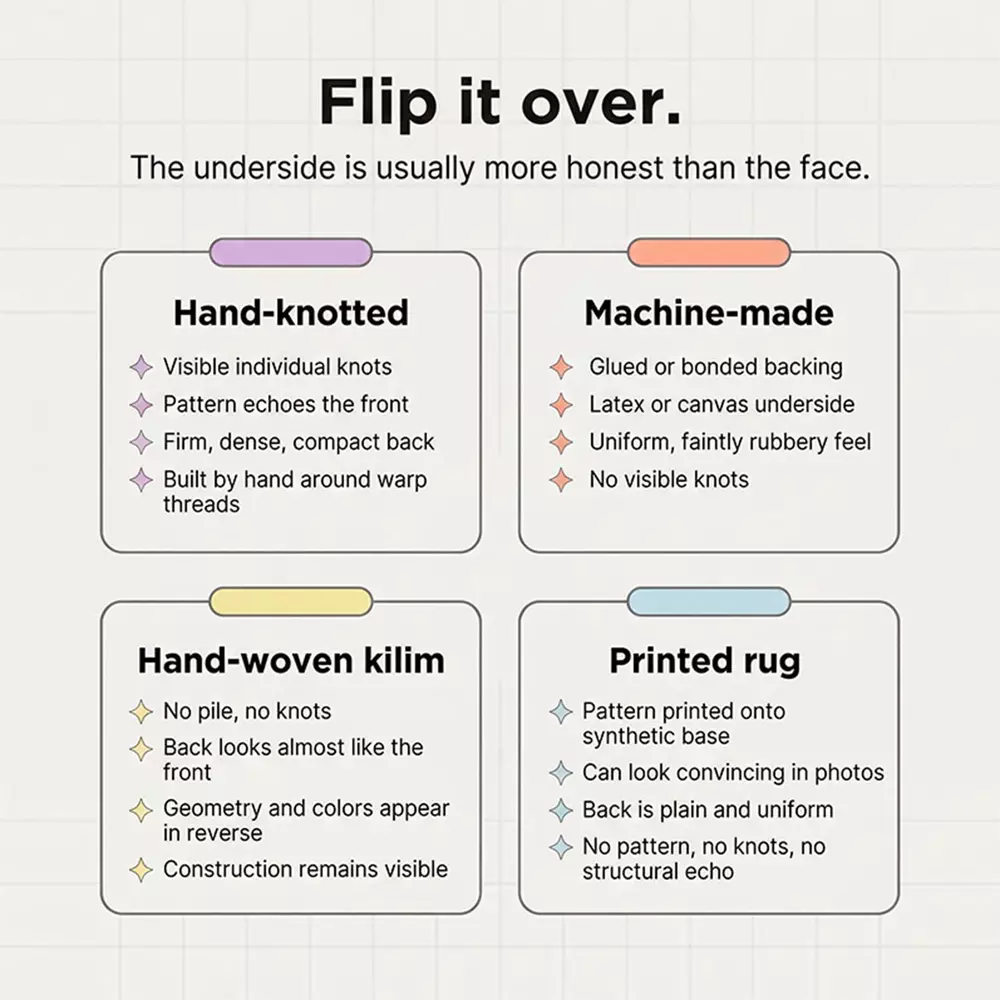
On a hand-knotted piece, Turkish, Persian, Anatolian, whatever the origin, you'll see the individual knots. Each one is tied by hand around the warp threads, and the pattern on the back mirrors the front with real structural fidelity. Not a photocopy of it, but a kind of echo you can trace. Run your fingernail lightly across the back: it's firm, slightly resistant, and the weave has a density that bonded or machine-made construction rarely replicates. When you press the pile from behind, there's a compactness to it, like something that was built rather than manufactured.
A machine-made rug often has a backing that's been glued or bonded on separately, sometimes a layer of latex, sometimes canvas, that feels uniform and faintly rubbery. There are no knots visible because the pile was inserted mechanically. You can usually tell within a few seconds of handling it.
Flatweaves like kilims work differently, no pile, no knots, but the same logic applies. The back of a hand-woven kilim looks almost identical to the front: the same geometry, the same color relationships, rendered in reverse. On a power-loomed approximation, the back tends to look indistinct, or there's a mesh backing glued over it to hide the construction.
There's a third category worth knowing about, and it's become more common as online rug retail has grown: printed rugs. A high-resolution image of a traditional or kilim-style pattern is printed directly onto a flat synthetic base, either a very low pile or a plain flatweave, and the result can look convincingly hand-woven in a product photo, or even from a few feet away in a shop. The giveaway is immediate the moment you flip it over: the back is plain, unmarked, and completely uniform. No pattern, no structural echo, no knots, just the raw underside of the base fabric. If you're buying online and can't handle the rug yourself, that missing backside photo is worth noticing.
The Knots Won't Be Perfectly Even
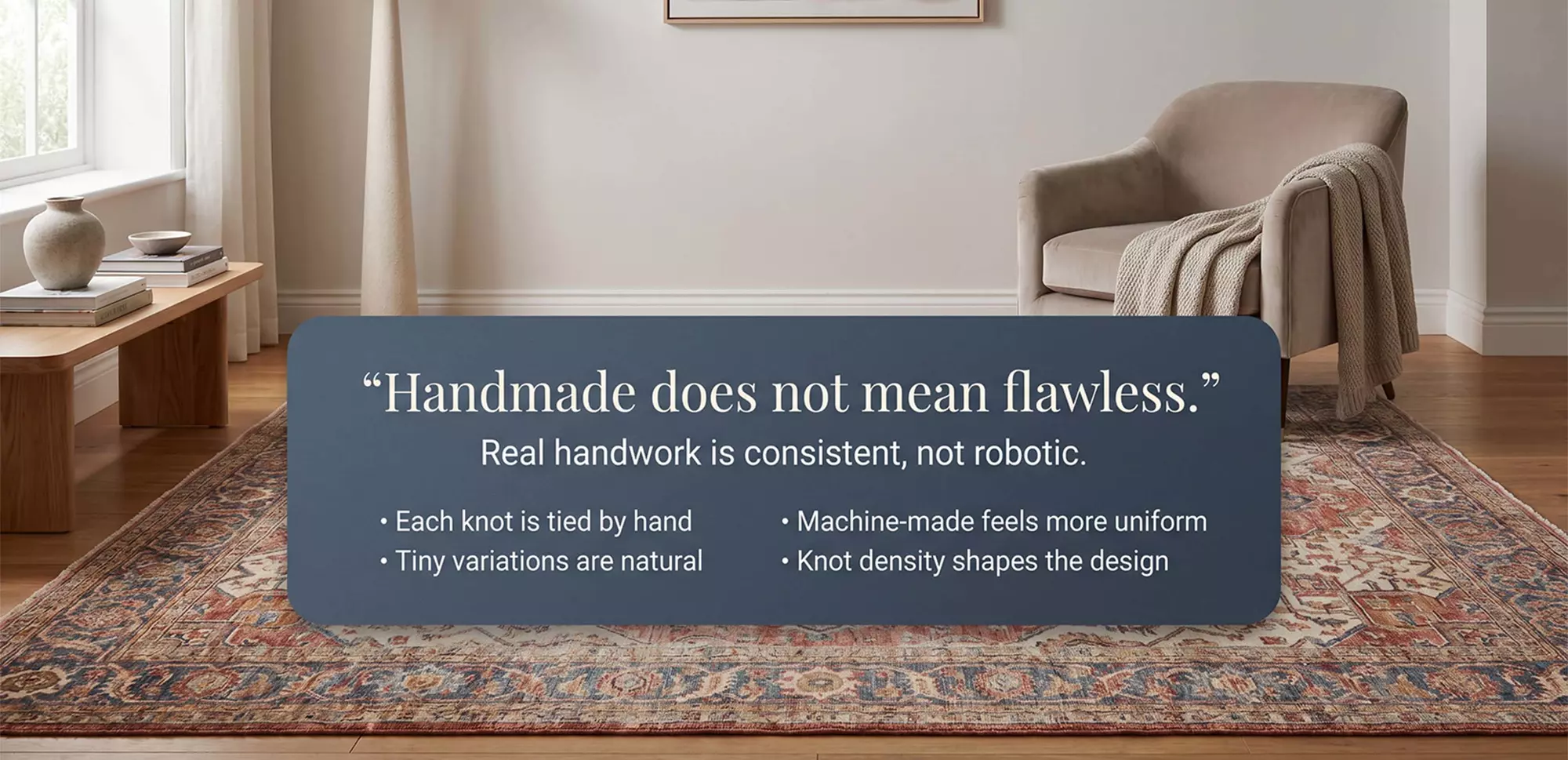
This trips people up, because the instinct is to assume that handmade means flawless. It doesn't or at least, not in that way.
In a hand-knotted rug, each knot is tied by a person. Skilled weavers work with real consistency, but across tens of thousands of knots, micro-variations accumulate. These aren't mistakes. They're the natural result of human hands working at a loom over days or weeks, different tension, slightly different rhythm, the work of multiple weavers across a single piece. Look closely at the back of a genuine hand-knotted rug and the knots will be coherent in character but not robotically identical. There's a slight organic quality to the spacing. A machine-made rug, even a well-made one, has a regularity that starts to feel algorithmic once you've handled enough of both.
Knot density also matters, though it's not a simple more-is-better equation. Finer rugs, particularly older pieces in wool or silk, have a higher count per square inch, which allows for intricate curvilinear drawing. Coarser rugs have a lower count and tend toward bolder, more angular designs. The density tells you something about the time involved, and also about what the weaver was trying to do.
Imperfection as Information
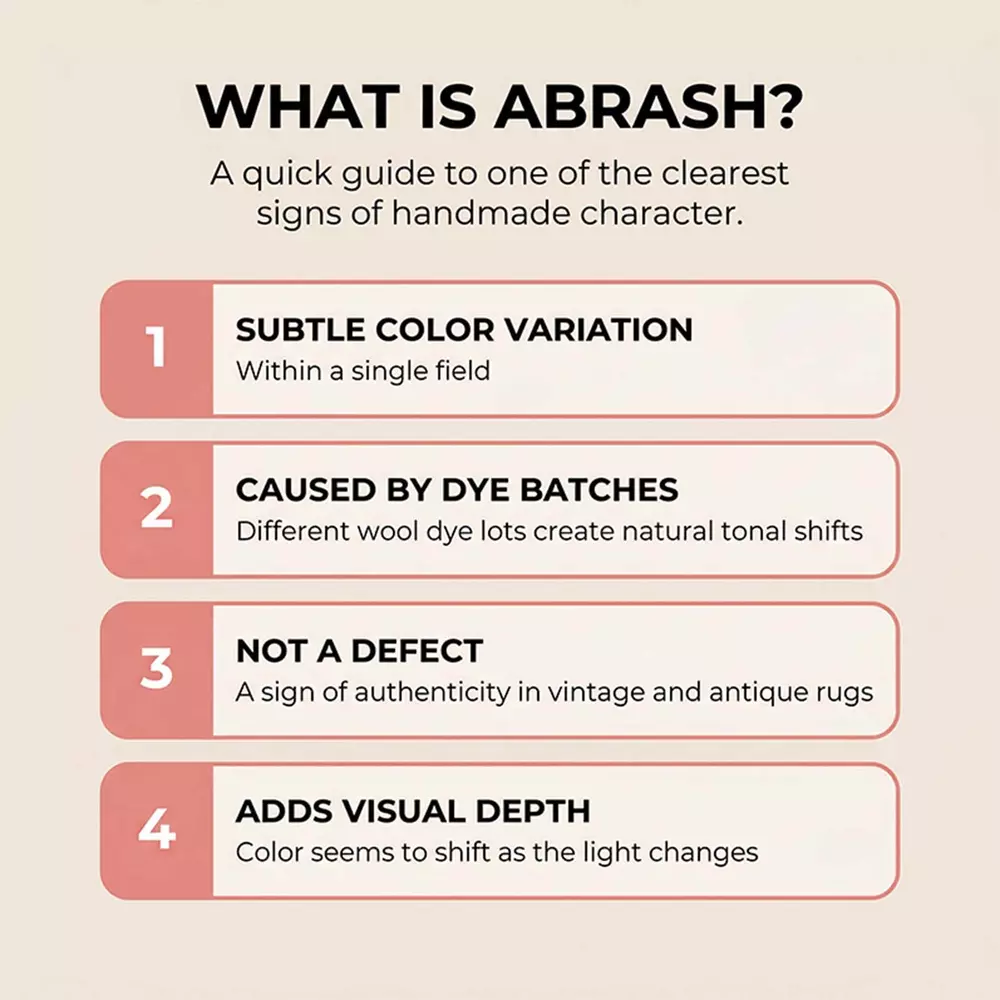
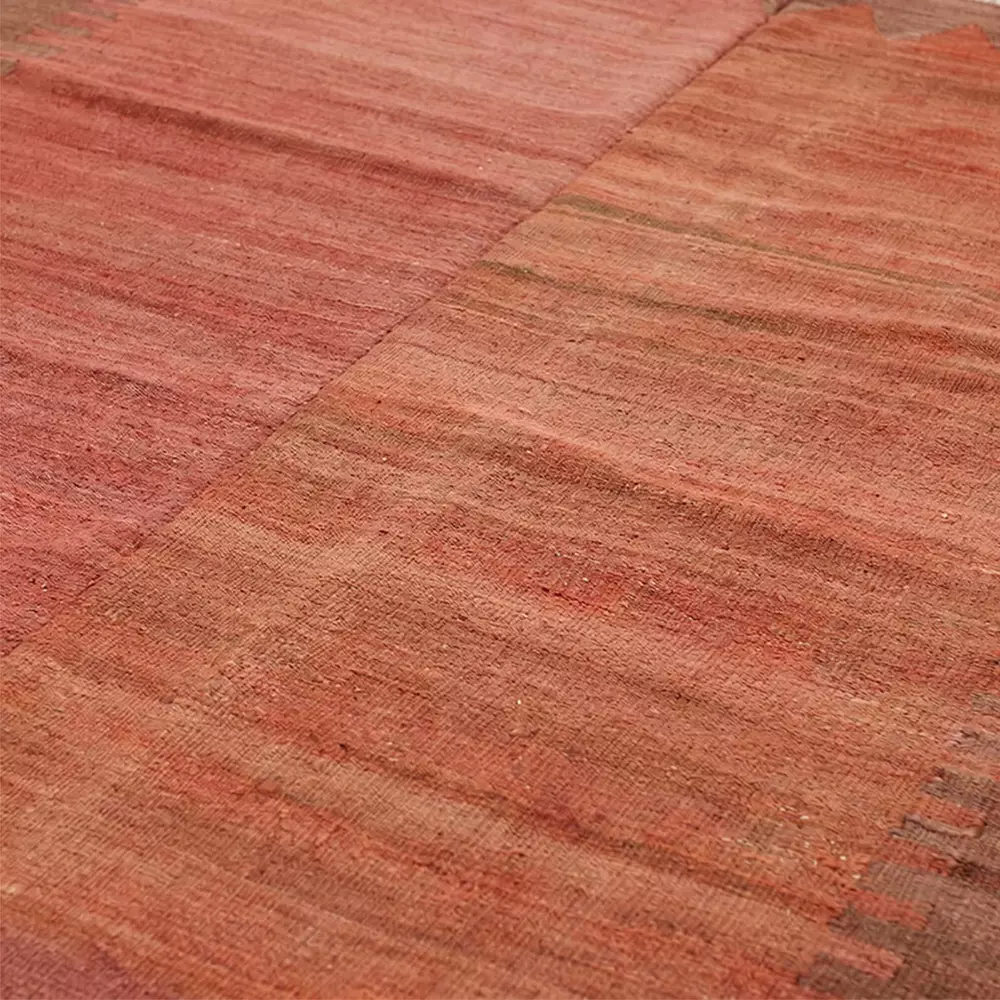
One of the most reliable signs of genuine handwork is what the trade calls abrash: subtle color variation across what's nominally a single field, a background that shifts from deeper indigo in one section to something dustier and softer elsewhere. It happens because wool was dyed in batches, and natural dye lots vary. Weavers worked with what they had on hand.
Abrash is not a defect. In vintage and antique pieces, it's close to a certificate of authenticity, and experienced collectors tend to seek it out rather than discount it. It gives a rug visual depth, the kind that photographs can suggest but a real room reveals, where the color seems to move slightly depending on the hour and the light.
Machine-made rugs have no abrash. Color is applied with industrial consistency, and the result is flat in a way that becomes more apparent the longer a piece sits in a lived-in space.
Other small irregularities are worth noticing too: a selvedge edge that's been hand-overcast in wool rather than serged by machine; a pattern repeat that's almost, but not quite, mathematically perfect; fringe that emerges from the rug rather than being attached to it. These are all traces of human making. They're also, in practice, what gives old rugs their particular appeal in an interior. The eye tends to relax into irregularity.
The Fringe Is Either Structural or It Isn't
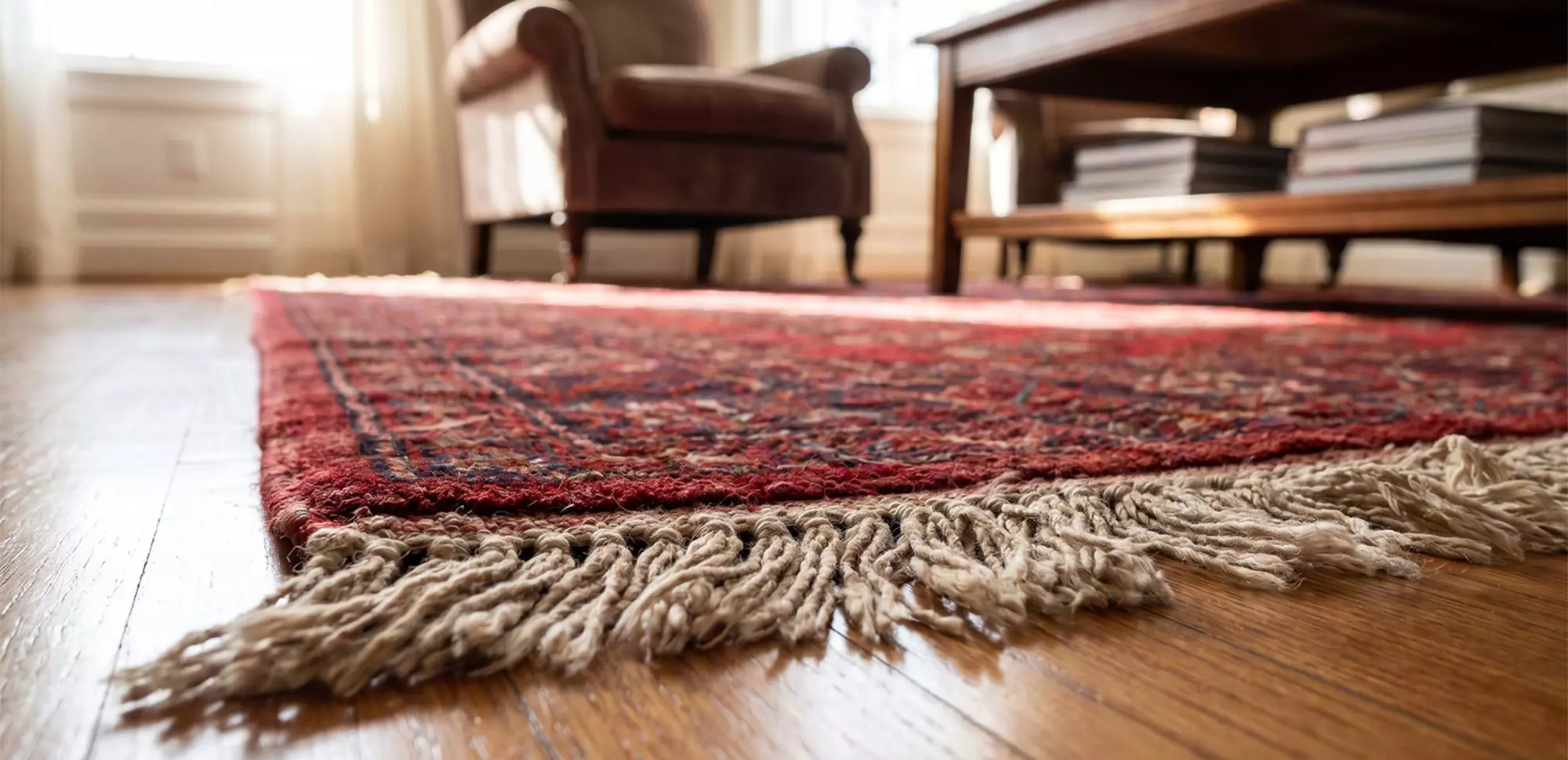
On a genuine hand-knotted rug, the fringe is structural. It's the continuation of the warp threads, the vertical threads that formed the loom's skeleton, extending beyond the knotted field at either end. Pull the fringe gently away from the rug body and you can trace those threads directly into the pile. They're the same threads. The fringe isn't decorative; it's what's left over after the weaving ends.
On many machine-made rugs, the fringe has been sewn or glued on after the fact. Look at the join: if there's a stitched seam, or the threads seem attached rather than continuous with the body of the rug, that's your answer. Some manufacturers have gotten good at making added fringe look convincing at a glance, but it doesn't hold up to a few seconds of close attention.
What the Wool Actually Feels Like
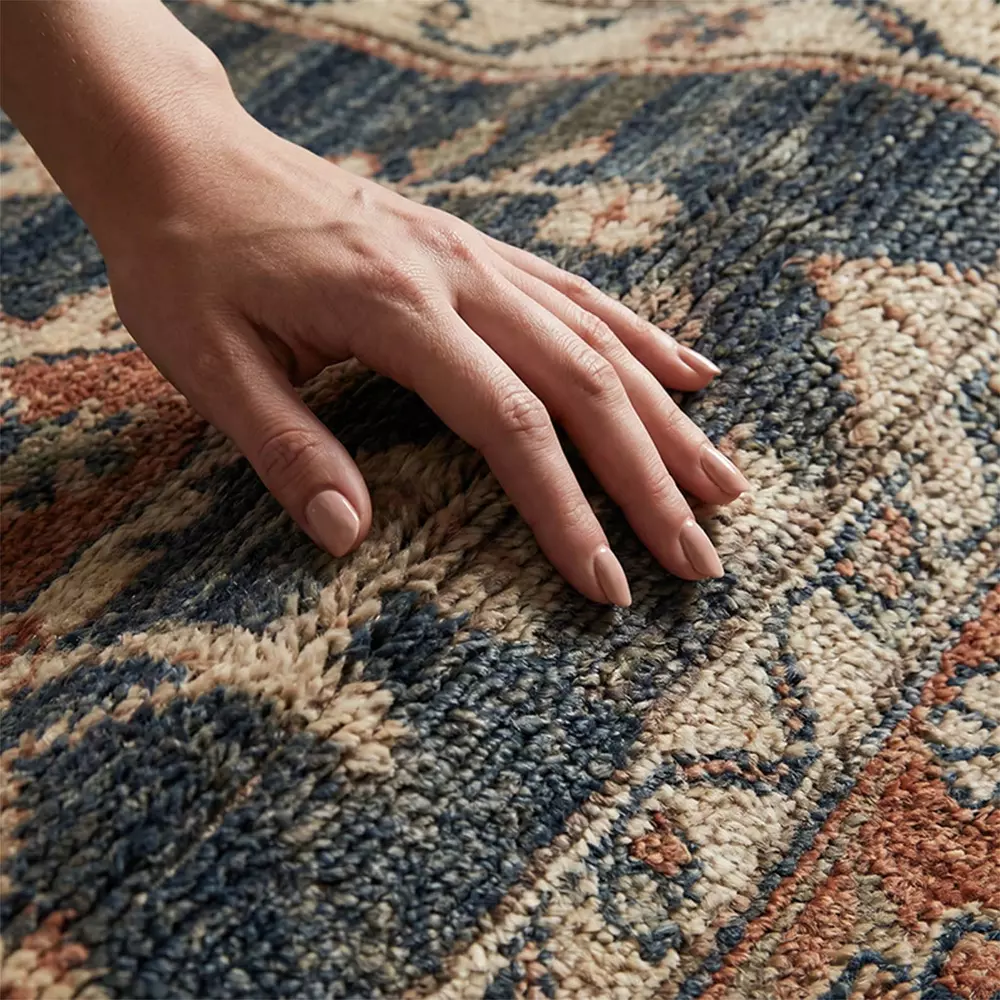
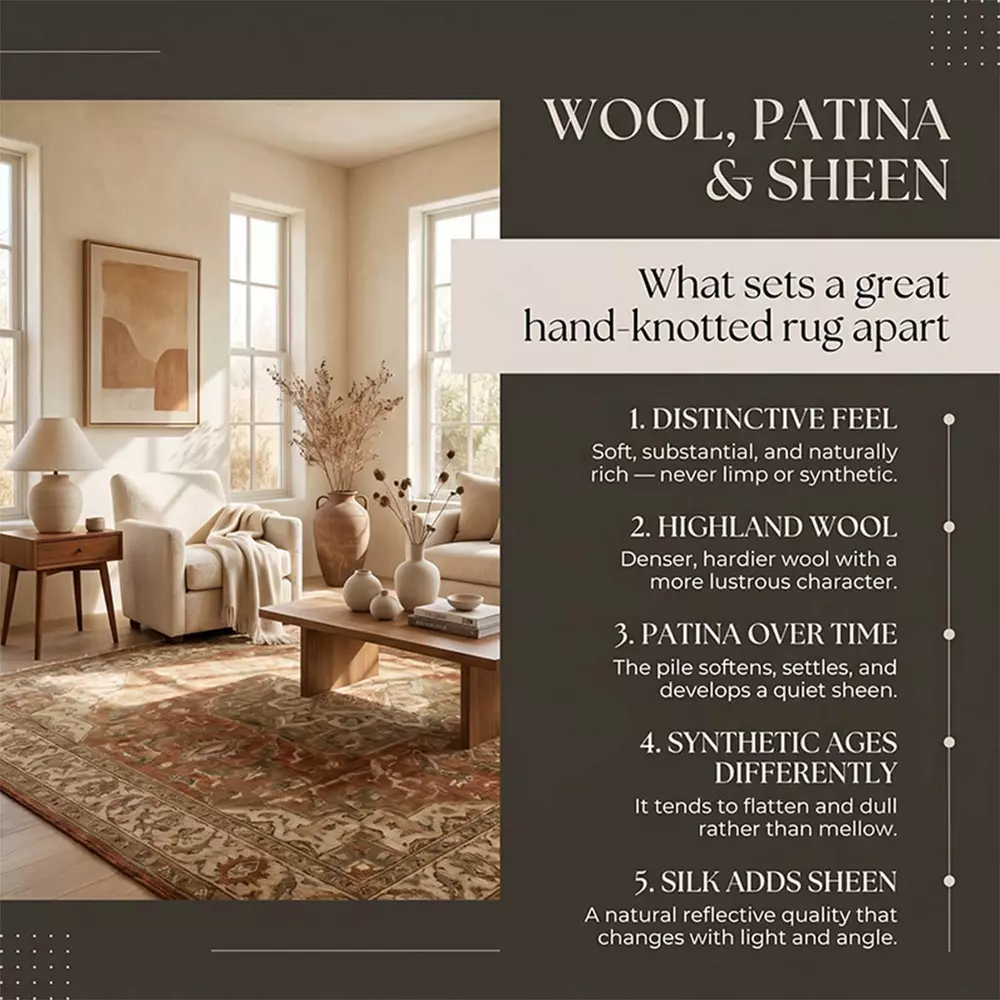
Good wool, the kind used in traditional hand-knotted rugs, has a particular hand. It's slightly lanolin-rich, with a softness that has some body to it. Not limp, not synthetic. Wool from sheep raised at altitude, as in much of highland Anatolia, tends to be hardier and more lustrous than lowland fleece. It's denser and holds dye differently, which is part of why old rugs from certain regions have colors that still look alive. After decades of use, this wool develops a specific patina: the pile compresses slightly, the surface takes on a quiet sheen, and the whole rug settles in a way that synthetic materials simply don't replicate.
Polypropylene and polyester pile feel lighter and slightly cool to the touch. In cheaper constructions there's an almost slippery quality. More to the point, they don't age in the same direction. They flatten and dull rather than mellowing. A wool rug generally looks better at twenty years than it did at two. A synthetic pile rug rarely does.
Silk, when present, adds a shifting reflective quality to the pile that changes with light and angle. It's used in finer pieces, often in combination with wool. The sheen is directional and natural in a way that manufactured alternatives approximate but don't quite get right.
The Edges
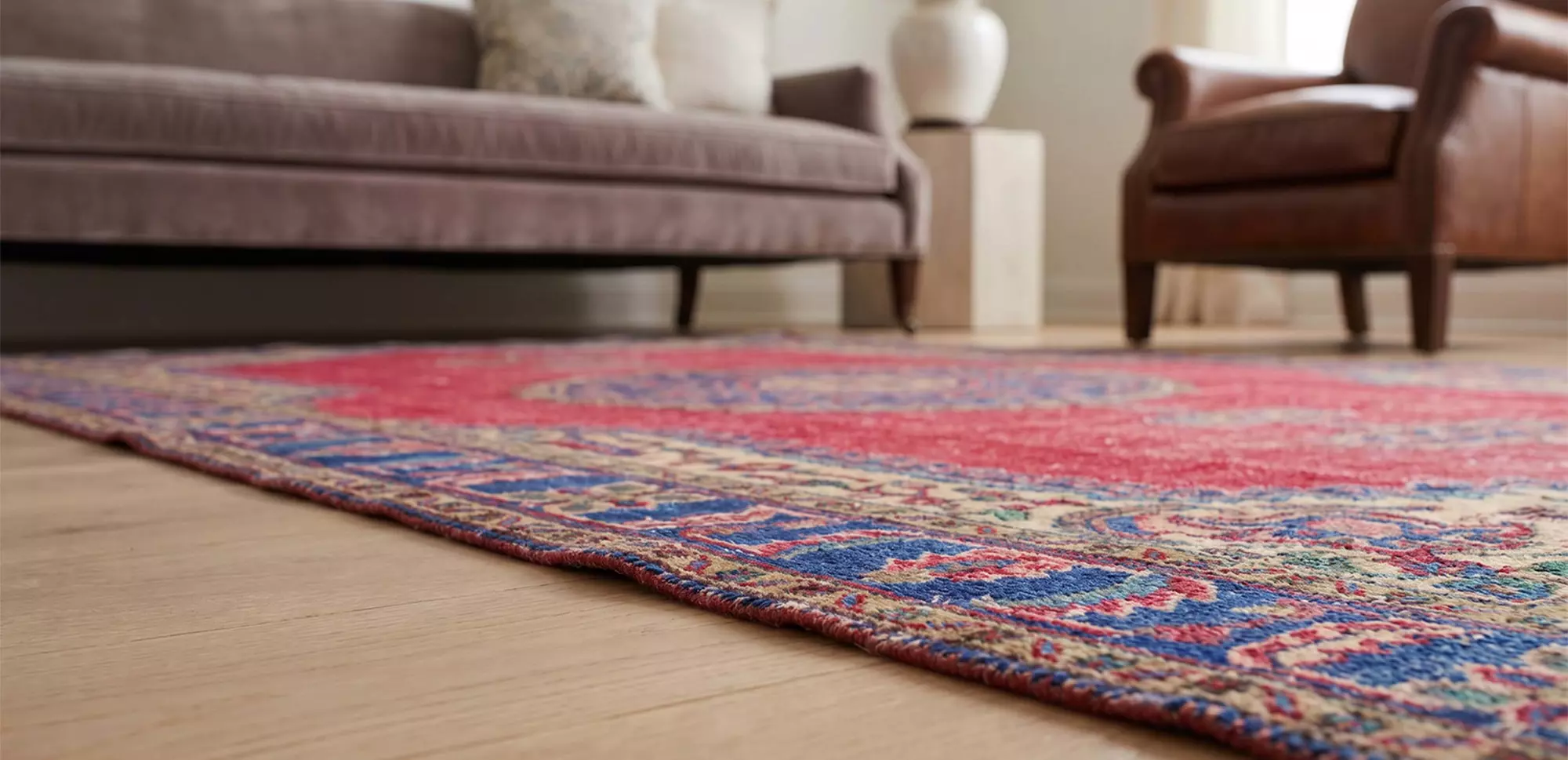
The long sides of a rug, the selvedges, are worth a look. On a hand-woven piece, the selvedge forms naturally as the weft threads turn back at each end of the loom. It may be reinforced by hand with overstitching, but it's part of the rug's structure. There's often a very slight irregularity along its length, not sloppy, just human.
Machine-made rugs tend to have cleaner, almost surgical edges, sometimes serged, sometimes bound with a finish that looks applied rather than integral. It's a small thing, but it's consistent. Once you've run your hand along enough selvedges, the difference registers immediately.
What You're Actually Choosing
None of this is an argument that machine-made rugs have no place. They're practical, they're accessible, and in the right context they work fine. But they're a different object, one that doesn't accumulate history, doesn't develop the particular surface character that comes with age and natural materials, and doesn't carry the evidence of someone's hands.
When you're choosing a rug for a space you genuinely care about, these differences matter in a way that's hard to articulate but easy to feel once you're living with it. A real handmade rug changes over time in ways that tend to improve it. The pile softens. The colors settle. The whole thing becomes more itself. That's not a romantic abstraction, it's just what actually happens, and it's worth knowing how to see it.
Kilim Studio specializes in authentic handwoven rugs, vintage, antique, kilim, and hand-knotted Turkish pieces, each selected individually. Browse the current collection at kilim.com.
